The Physics of Options: Synergy Between Delta and Gamma

[!NOTE] Combining Delta (Velocity) and Gamma (Acceleration) is the secret to professional risk management.
Many traders view the "Greeks" as abstract mathematical formulas hidden behind complex models. However, if you understand the basic physics of movement—Velocity and Acceleration—you already understand Delta and Gamma better than most.
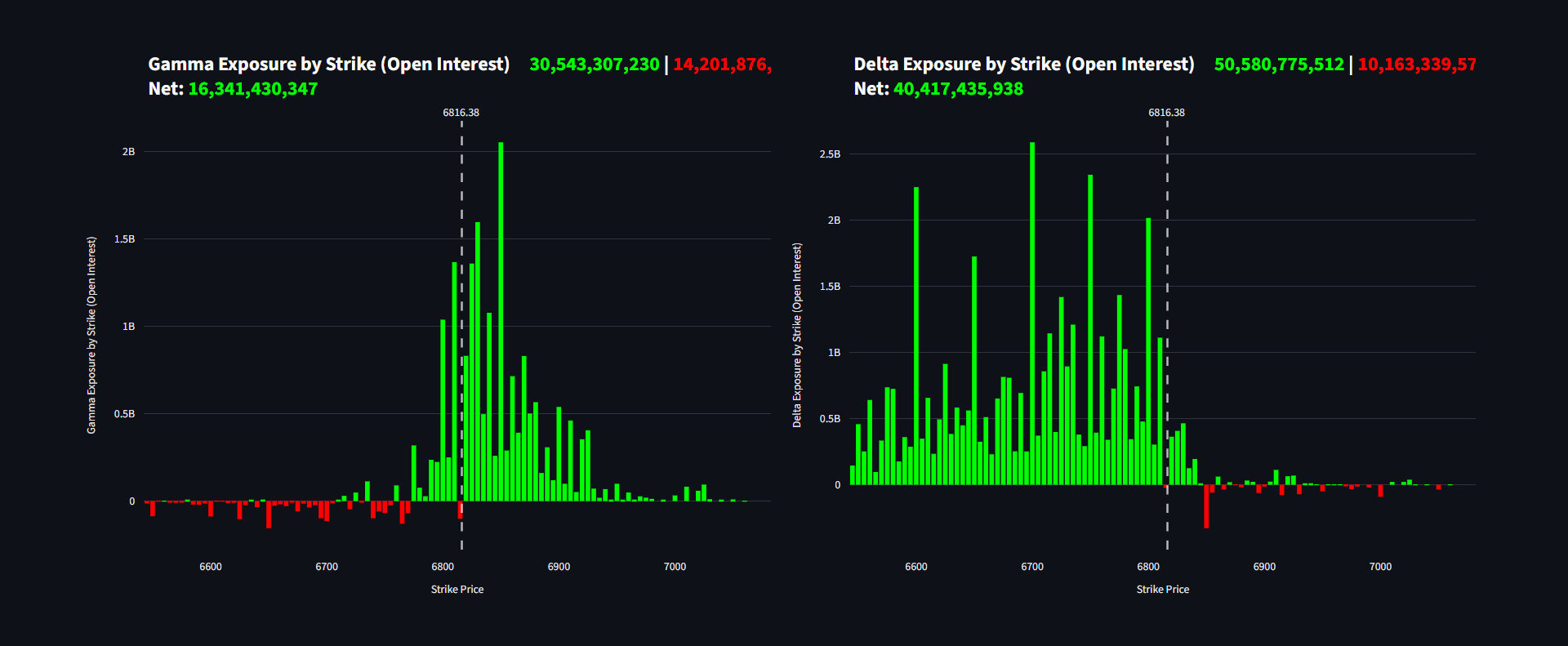 Visualizing the relationship between Delta and Gamma.
The Physics Analogy: The Accelerating Car
Imagine you are driving a high-performance sports car on a straight highway.
1. Delta is your Velocity ()
Delta measures how far your option's price moves for every $1 change in the underlying asset. In physics terms, this is Velocity. It tells you how fast you are gaining (or losing) money as the stock moves.
- Cruising at 50 mph: Your Delta is 0.50. For every mile the market travels, you move forward half a mile.
- Full Speed at 100 mph: Your Delta is 1.00. You are now moving "dollar-for-dollar" with the stock.
2. Gamma is your Acceleration ()
Gamma is the rate at which your Delta (Velocity) changes. In physics, this is Acceleration. It measures how hard you are pressing the gas pedal.
- Low Gamma: You are on cruise control. Your speed (Delta) remains constant.
- High Gamma: You are floored. Your speed (Delta) is jumping from 20 to 50 to 80 mph in seconds. This is where the "explosive" profits (or losses) happen.
Translating Physics to the Market
Now, let's take these physical concepts and apply them to an actual trading desk.
The Momentum of the "In-the-Money" (ITM) Move
When a stock approaches your strike price, your Gamma (Acceleration) hits its peak. This is like the moment a turbocharger kicks in. Your Delta (Velocity) starts increasing rapidly. Suddenly, what was a slow-moving position becomes a high-speed vehicle.
Traders love this "positive acceleration" because it means their win size grows faster as they are proven right.
The Danger of "Short Gamma" (The Braking Problem)
Selling options is equivalent to being Short Gamma. In our physics analogy, this is like being in a car where the brakes are failing while you are heading downhill. As the stock moves against you, your Delta increases unfavorably, making you lose money at an accelerating rate. You have to work twice as hard just to stay in the same place.
Why You Must Monitor Both
Understanding Delta without Gamma is like looking at a speedometer but ignoring the fact that your foot is floor-boarding the accelerator. You might be at 60 mph now, but in three seconds, you’ll be at 100 mph.
- Delta Neutral Trading: Market makers aim for a "Zero Velocity" state—they don't want to care where the stock goes. But to stay at zero, they must constantly combat Gamma (Acceleration) by buying and selling the underlying asset.
- The Gamma Squeeze: This is a physics-driven market event. When everyone buys calls, market makers are forced to buy the stock to hedge. This buying increases the stock price, which increases the Delta (Acceleration), which forces even more buying. It's a feedback loop of pure kinetic energy.
Professional Insight
"Delta tells you where you are; Gamma tells you where you are going to be."
In conclusion, mastering the synergy between Delta and Gamma allows you to see the market not as a series of static prices, but as a dynamic field of energy. By understanding the physics of your profit engine, you can better time your entries, manage your hedges, and avoid the "crashes" that come from ignoring acceleration.