Vanna: The Bridge Between Price and Volatility

As traders move beyond the primary Greeks (Delta, Gamma, Theta, Vega), they enter the world of Second-Order and Cross-Greeks. Among these, Vanna is perhaps the most critical for understanding how institutional liquidity providers manage their risk in volatile markets.
If Delta is the directional propeller and Gamma is the accelerator, Vanna is the steering wheel that adjusts based on the "weather"—the implied volatility.
What is Vanna?
Mathematically, Vanna is a cross-derivative. It measures the rate of change of an option's Delta with respect to changes in Implied Volatility (IV).
Interestingly, due to the beauty of calculus, Vanna also measures the rate of change of an option's Vega with respect to changes in the Underlying Price.
In simple terms: Vanna tells you how much more (or less) "directional" your position becomes as the market gets more volatile.
Why Does Vanna Matter?
Vanna is the secret sauce for institutional hedging. When market makers are "Short Vanna," a rise in volatility forces them to buy or sell the underlying asset to remain Delta-neutral.
1. The Volatility-Squeeze Connection
When volatility spikes during a market sell-off, Vanna dictates that call options lose Delta and put options gain Delta. Market makers must then adjust their hedges, which can lead to rapid price movements—often referred to as a "Vanna Squeeze" or "Vanna Unwinding."
2. Strategic Positioning
Professional traders look at Vanna "walls" to identify levels where institutional hedging will likely provide support or resistance.
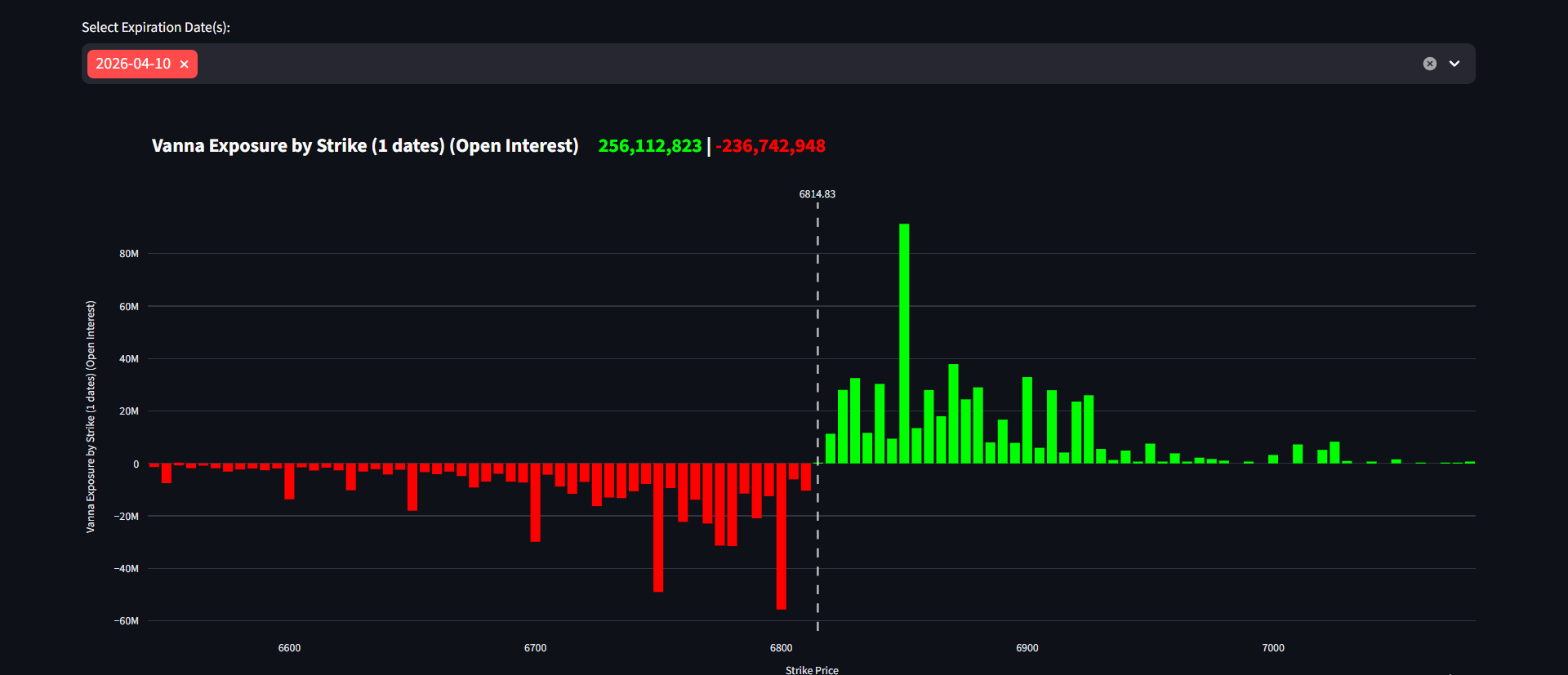 Typical Vanna exposure across SPX strikes.
As shown in the chart above, Vanna clustering at specific strike prices (like significant put walls) can act as a magnet for price action or a hard floor during high-volatility events.
Vanna in the Physics Context
Following our physics analogy:
- Delta: Velocity.
- Gamma: Acceleration.
- Vanna: Is like changing the Drag Coefficient of your vehicle. As the "air" (Volatility) gets thicker or thinner, your speed (Delta) changes even if your foot stays still on the gas.
Summary for Advanced Risk Managers
- Positive Vanna: Typically found in Calls. When IV rises, the Delta of the Call increases.
- Negative Vanna: Typically found in Puts. When IV rises, the Delta of the Put becomes more negative (position becomes "shorter").
- Hedging Logic: Understanding Vanna allows you to predict when others will be forced to trade, giving you a significant edge in timing market reversals.
Vanna is where the "Math" meets the "Machine." By mastering this bridge, you move from trading price action to trading the actual structure of the market itself.